May 8, 2026
Mortgage Affordability in Glasgow: How Lenders Assess Your Income


One of the most common questions buyers ask before starting their property search is a simple one: can I actually afford a house in Glasgow when buying a home? The honest answer depends less on a single number and more on how lenders assess the complete picture of your finances. Mortgage affordability Glasgow calculations are not just about salary. Lenders weigh your income against your outgoings, your debts, your deposit, and how your repayments would hold up if interest rates rose.
Understanding how that process works, and what it means in the context of Glasgow's current property market, puts you in a far stronger position before you approach a lender or apply for an agreement in principle Glasgow. Whether you are purchasing your first property, moving home, or investing in rental properties, knowing how affordability is assessed can help you plan more effectively.
This guide explains exactly how lenders assess affordability in 2025, what the numbers look like against Glasgow's market, and what you can do to improve your borrowing position when buying a home or expanding your portfolio of rental properties.
How Much Can You Borrow for a Mortgage in Glasgow?
The starting point for any mortgage affordability Glasgow calculation is income. Most lenders use an income multiple as the upper boundary of what they will lend, then apply an affordability stress test on top of that to make sure repayments are genuinely sustainable.
According to MoneyHelper, the standard cap most lenders apply is 4.5 times your gross annual income. Some lenders will go higher, depending on your circumstances.
Here is how those multiples translate against Glasgow's property market in practice:
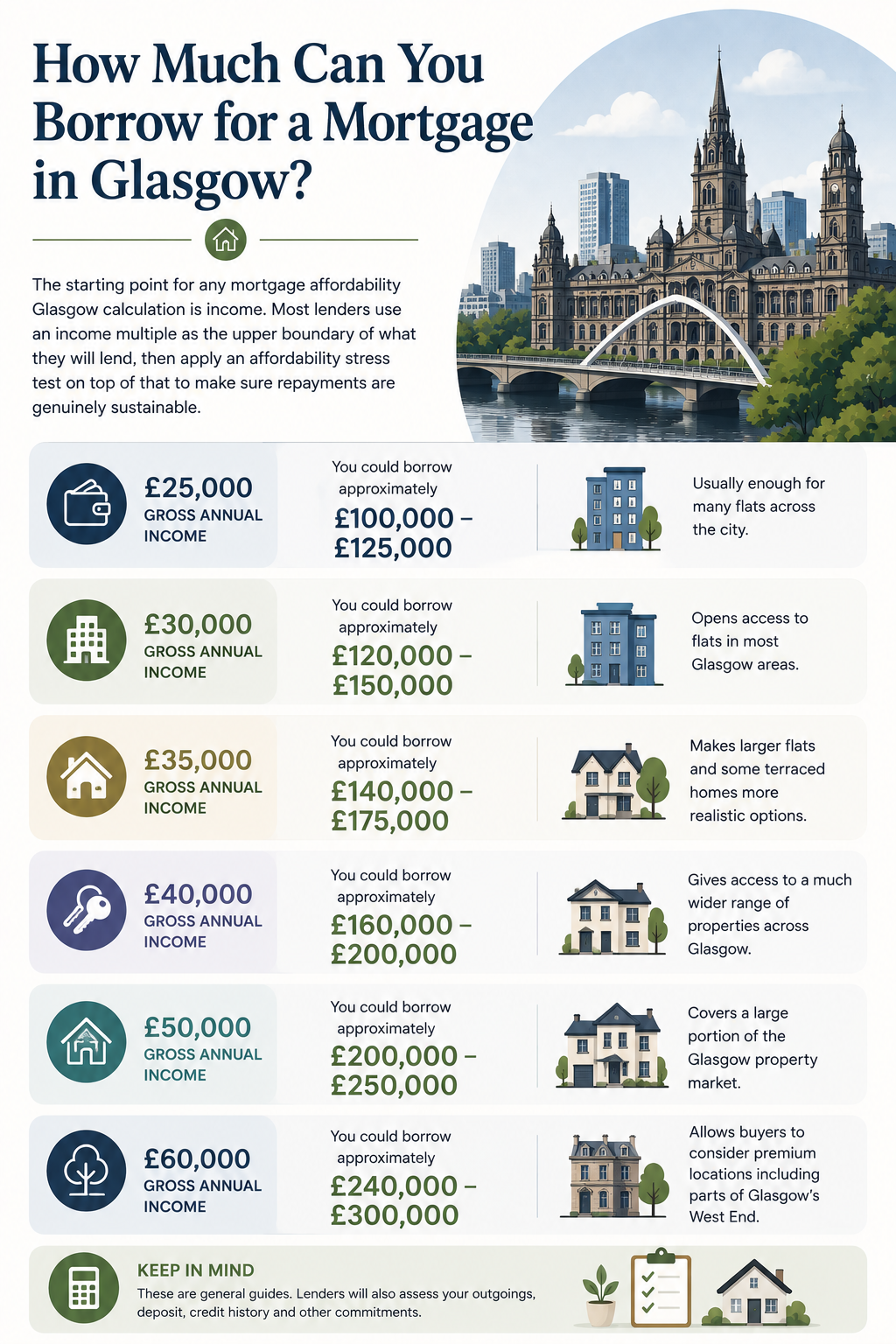
- A gross annual income of £25,000 would typically allow borrowing between £100,000 and £125,000, depending on whether a lender offers 4x, 4.5x, or 5x income multiples. In Glasgow, that budget is usually enough for many flats across the city.
- With an income of £30,000, borrowing potential rises to around £120,000–£150,000, opening access to flats in most Glasgow areas.
- At £35,000 per year, buyers could usually borrow between £140,000 and £175,000, making larger flats and some terraced homes more realistic options.
- A £40,000 salary could support borrowing from £160,000 to £200,000, giving access to a much wider range of properties across Glasgow.
- For households earning £50,000 annually, borrowing capacity often reaches £200,000–£250,000, which covers a large portion of the Glasgow property market.
- At £60,000 gross income, borrowing potential can rise to between £240,000 and £300,000, allowing buyers to consider premium locations including parts of Glasgow’s West End.
According to ONS data for Glasgow, the average price paid by first-time buyers was £167,000 in February 2026, up 2.1% year on year. For home movers, the average was £229,000. These figures show that Glasgow remains genuinely accessible at a range of income levels, particularly compared with Edinburgh where the first-time buyer average sits at £248,000.
These borrowing multiples are a guide, not a guarantee. The actual offer you receive depends on what lenders find when they run their full affordability assessment.
How Lenders Actually Assess Mortgage Affordability
Income multiples tell you the theoretical ceiling. Lender affordability assessments determine what you are actually offered. These are two different things, and understanding the distinction matters, especially when working with a Specialist approach to complex cases or non-standard income scenarios.
Since the Mortgage Market Review of 2014, lenders are required to carry out detailed affordability assessments rather than simply applying a salary multiple. That means every application involves a thorough review of income, outgoings, and financial resilience, with some applicants benefiting from a Specialist lending route where circumstances fall outside mainstream criteria.
Income: what lenders count and what they discount
Lenders begin with your verifiable gross income, but not every income source is treated equally.
Employed income from a permanent contract is the most straightforward. Your basic salary is counted in full. Overtime, bonuses, and commission are treated more cautiously. Many lenders will count 50% to 60% of regular overtime and bonuses. Some will count 100% if you can demonstrate a consistent track record over two years. Irregular or one-off bonuses are often excluded entirely.
Self-employed income is assessed differently depending on how your business is structured. Sole traders are typically assessed on their net profit as shown in their tax returns, usually averaged over the most recent two years. Limited company directors face more variation: some lenders assess on salary plus dividends, others on salary plus share of net profit. The lender used for a self-employed application in Glasgow matters significantly. A whole-of-market mortgage broker Glasgow can identify which lenders are most receptive to your specific trading structure.
Additional income sources that some lenders will count include: child maintenance payments (with a court order or written agreement), rental income from other properties (usually at 75% to 80% of the declared amount), investment dividends, and certain benefit income. The inclusion of these varies considerably between lenders, which is another area where a broker adds tangible value.
Income sources most lenders will not count include: casual or cash-in-hand work without documentation, income from a business trading less than 12 months, and most student loan payments or bursaries.
The affordability stress test
This is the mechanism that most often catches buyers off guard. Lenders do not simply check that you can afford repayments at today's rate. They check whether you could still afford repayments if interest rates rose significantly, typically to around 6% to 8% above the current base rate, depending on the lender's model.
The Scottish Government's Housing Market Review Q3 2025 recorded that for first-time buyers in Scotland, capital and interest payments represented 19.8% of gross income for new mortgages in Q2 2025. At the peak in 2023, that figure reached 20.5%. The stress test is designed to ensure that figure stays manageable even if rates rise from current levels.
In practice, this means the amount a lender offers you at today's rates may be materially lower than your income multiple would suggest, because they are stress-testing your ability to service a higher rate. The tighter your existing monthly commitments, the more the stress test compresses what you can borrow.
Monthly outgoings: what lenders examine
Lenders review your recent bank statements, typically three to six months, alongside your credit file to build a picture of your spending. Categories they assess include:
Fixed financial commitments: Monthly debt repayments on credit cards, personal loans, car finance, student loans, and any other credit agreements. Every £100 per month in existing debt repayments typically reduces your maximum mortgage by around £15,000 to £20,000, depending on the lender.
Essential living costs: Council tax, utilities, grocery spending, and childcare costs. Lenders use a combination of declared figures and statistical benchmarks to assess these.
Discretionary spending: Subscriptions, dining out, holidays, and leisure. Some lenders apply stricter scrutiny here than others. Several months of consistently high discretionary spending can affect how lenders interpret your application.
Gambling transactions: Regular gambling transactions on bank statements are treated as a significant red flag by many lenders, even when the amounts are small. This is one of the less-publicised factors that affects mortgage affordability Glasgow applications.
Income Needed for a Mortgage in Glasgow: Real Figures
Glasgow's property market data makes it possible to be specific about the income needed Glasgow mortgage for different property types. Using the ONS Glasgow housing data and a standard 10% deposit:
Here it is in a clean, readable paragraph format:
- A typical Glasgow first-time buyer flat averages around £167,000, which would require a £150,300 mortgage with a 10% deposit. This equates to roughly £33,400 income needed at 4.5x borrowing, or £37,575 at 4x borrowing.
- For terraced homes in areas like the Southside or East End, the average price is around £185,000. With a 10% deposit, the mortgage needed would be about £166,500, requiring approximately £37,000 income at 4.5x or £41,625 at 4x.
- Semi-detached homes in the suburbs typically sit around £225,000. After a 10% deposit, the mortgage required is about £202,500, meaning an income of roughly £45,000 at 4.5x or £50,625 at 4x.
- In the West End, flats or terraced properties average around £270,000. This would require a £243,000 mortgage, with income needs of about £54,000 at 4.5x or £60,750 at 4x.
- For home movers across Glasgow, the average property price is around £229,000. With a 10% deposit, the mortgage required is about £206,100, needing roughly £45,800 income at 4.5x or £51,525 at 4x.
These figures assume a single applicant and a standard 10% deposit. Joint applicants combine their incomes, which significantly expands what is affordable. A couple each earning £28,000 (£56,000 combined) can, at 4.5x, borrow up to £252,000, which gives them access to a substantial portion of Glasgow's property stock.
The Scottish Housing Market Review recorded the average house-price-to-income ratio for first-time buyer mortgages in Scotland at 3.0 in Q2 2025, meaning the typical first-time buyer in Scotland is borrowing at a ratio well below the 4.5x maximum. In Glasgow specifically, where first-time buyer prices remain below the Scottish average for more expensive areas, this ratio is achievable at moderate income levels.
What Reduces Your Borrowing Capacity
Several factors that buyers often underestimate can meaningfully reduce how much a lender will offer, even when the income multiple looks sufficient.
Existing debt commitments
Every regular debt repayment reduces your disposable income in the lender's affordability model. A £300 per month car finance payment, a £150 per month personal loan, and a £100 minimum credit card payment combine to £550 per month in committed outgoings. At a typical lender's affordability rate, that level of committed debt could reduce your maximum mortgage by £80,000 to £100,000.
Paying down revolving credit balances before applying, and avoiding new credit commitments in the six to twelve months before a mortgage application, are the two most effective steps most buyers can take to improve their borrowing capacity.
Number of financial dependants
Childcare costs and the financial obligations of raising children are factored into lender affordability models. The impact varies between lenders, but declared childcare costs are typically included in full. Two applicants with two children in full-time childcare can face materially different affordability assessments than two applicants without dependants at the same income level.
Employment gaps or recent career changes
Most lenders prefer to see at least three to six months in a current employed role before they will consider an application. Applicants who have recently changed jobs, even to a higher salary, may find that some lenders require them to have completed a probationary period before applying. Self-employed applicants with less than two years of trading history face the most restricted product range, though specialist lenders exist.
Loan-to-value ratio
The LTV of your application affects which lenders are available and what rates they offer. Borrowers at 95% LTV face a narrower lender market and higher rates than those at 90%, 85%, or 80%. A higher rate means higher monthly repayments, which feeds back into the affordability assessment and can reduce the amount a lender is willing to offer.
How an Agreement in Principle Works in Glasgow
An agreement in principle Glasgow is a conditional statement from a lender confirming the approximate amount they would be willing to lend, based on the information provided at that stage. It is not a mortgage offer, and it is not a guarantee, but it serves several important practical purposes.
What it does: An AIP gives you a reliable borrowing ceiling to search within, signals to sellers and solicitors that you are a prepared buyer, and allows you to act quickly at a closing date without scrambling to confirm your financial position under time pressure.
How lenders issue AIPs: Some lenders issue AIPs based on a soft credit search, which does not leave a mark on your credit file. Others conduct a hard search at the AIP stage. If you are applying directly with multiple lenders to compare, multiple hard searches in a short period can affect your credit score. A broker typically conducts a single soft search and places your AIP with the most appropriate lender, avoiding unnecessary credit file enquiries.
How long it lasts: Most AIPs are valid for 60 to 90 days. If your property search extends beyond that window, the AIP will need to be renewed. This is straightforward if your circumstances have not changed.
What it does not cover: An AIP based on estimated income and self-declared outgoings is not the same as a fully underwritten application. Lenders verify all information at full application stage, and discrepancies between what was declared at AIP and what documentation shows can result in a lower offer or a declined application. This is why the preparation that goes into an AIP matters as much as the AIP itself.
A mortgage broker Glasgow will prepare your AIP in a way that reflects your full, verified financial position, minimising the gap between what the AIP confirms and what a full application produces.
How Glasgow's Property System Affects Affordability Planning
Glasgow follows the Scottish property buying system, which introduces specific affordability considerations that buyers from England, or buyers relying on generic UK mortgage guidance, need to understand.
Home Report valuation caps your mortgage
In Scotland, sellers are legally required to commission a Home Report before marketing a property. The Home Report contains a surveyor's valuation, and lenders base your mortgage on that valuation, not the price you offer.
In practice, Glasgow buyers in competitive areas regularly offer above the Home Report value. The ONS Glasgow housing data shows that home movers paid an average of £229,000 in February 2026, while many sought-after areas see offers significantly above Home Report value. Any premium above that valuation comes from your own funds, on top of your deposit.
This means your true cash requirement for a Glasgow purchase is often higher than your mortgage and deposit calculation alone suggests. Effective mortgage affordability Glasgow planning accounts for this buffer before you begin making offers.
Closing dates compress decision timelines
When a Glasgow property attracts competing interest, the seller's solicitor may set a closing date: a fixed deadline by which all sealed bids must be submitted. Acting confidently at a closing date requires knowing your exact borrowing position in advance, not in principle.
An AIP prepared thoroughly before you begin viewing properties means you can confirm your position and submit a competitive offer within the 48 to 72 hour windows that closing dates typically create.
Missives create legal commitment earlier
Once missives are concluded in Scotland, both buyer and seller are legally committed to the transaction. There is no equivalent of the English "subject to contract" period where either party can walk away without consequence. Your mortgage position needs to be solid before that point, not still under review.
What Improves Your Mortgage Affordability in Glasgow
Understanding what lenders look for makes it possible to take practical steps that genuinely improve your position before you apply.
Reduce revolving credit balances: Paying a credit card balance from 80% utilisation to under 30% improves your credit score and reduces your declared monthly commitments. Both help your affordability assessment.
Clear smaller debts entirely: A fully cleared personal loan or credit agreement removes that monthly commitment from the lender's model entirely. Even a relatively small monthly payment, when removed, can improve your maximum offer by more than its face value suggests.
Avoid new credit in the six months before applying: New credit applications trigger hard searches and signal financial change to lenders. Hold off on any new finance, including buy now pay later arrangements, in the period leading up to your mortgage application.
Document all income sources thoroughly: If you have additional income beyond your basic salary, such as regular overtime, a second job, rental income, or freelance work, gather documentation to support it. Income you cannot evidence is income a lender cannot count.
Build your deposit toward the next LTV band: Moving from 95% to 90% LTV, or from 90% to 85%, typically produces a meaningful improvement in available rates and lender choice. Even a few additional months of saving can shift you into a significantly better product tier.
Speak to a whole-of-market broker before applying: Different lenders treat the same income profile differently. A broker who knows which lender's affordability model fits your circumstances gets you a higher offer from the right source, rather than a declined application from the wrong one.
How Much Can I Borrow in Glasgow: Summary by Scenario
To make these calculations concrete, here are worked examples using current Glasgow market data.
Scenario 1: Single applicant, employed, £32,000 salary, no significant debts, 10% deposit At 4.5x income: potential borrowing of £144,000. With a 10% deposit of approximately £16,000, total purchase budget of around £160,000. This gives access to most of Glasgow's flat market, including popular areas such as Dennistoun, Govan, and parts of the Southside.
Scenario 2: Joint applicants, £28,000 and £24,000 salaries, one small car loan (£180/month), 10% deposit Combined income £52,000. At 4.5x: potential borrowing of £234,000 before the car loan is factored in. The existing car loan commitment would reduce this somewhat depending on the lender's model, likely to around £210,000 to £220,000. With a 10% deposit, this gives a purchase budget of approximately £230,000 to £245,000, covering a wide range of Glasgow property including semi-detached homes in areas like Shawlands, Battlefield, and Cathcart.
Scenario 3: Self-employed applicant, 3 years trading, net profit averaging £45,000, 15% deposit At 4.5x based on a two-year average net profit: potential borrowing of around £202,500. With 15% deposit on a £240,000 property, this scenario is workable, but lender selection matters significantly. Not every lender assesses self-employed net profit in the same way. A broker familiar with self-employed mortgage criteria is essential here.
Scenario 4: First-time buyer, £38,000 salary, student loan, 5% deposit At 4.5x income: potential borrowing of £171,000. The student loan reduces disposable income in the affordability model, which may bring the actual offer down to £155,000 to £165,000 depending on the lender. With a 5% deposit, purchase budget in the region of £163,000 to £174,000 covers most Glasgow flats and some terraced properties.
Frequently Asked Questions
How much income do I need for a mortgage in Glasgow?
The income needed depends on the property price and deposit. Using the Glasgow first-time buyer average of £167,000 and a 10% deposit of £16,700, the mortgage required is £150,300. At a standard 4.5x income multiple, that requires a gross annual income of approximately £33,400. At 4x, the income requirement rises to around £37,600. For joint applicants, the combined income is used, which significantly reduces the individual income needed. These figures are a guide. Lenders also assess monthly outgoings, existing debts, and the affordability stress test, which can reduce the actual offer below the income multiple ceiling.
How much can I borrow for a mortgage in Glasgow?
Most lenders will consider lending between 4 and 4.5 times your gross annual income, with some prepared to go to 5 or 5.5 times for applicants with strong profiles, higher incomes, or certain professional backgrounds. On a £40,000 salary, that means a potential borrowing range of £160,000 to £200,000 before the full affordability assessment is applied. With existing debts or significant monthly commitments, the actual offer may be lower than the maximum multiple suggests. A whole-of-market mortgage broker Glasgow can assess which lender's model produces the best outcome for your specific profile.
What is an agreement in principle in Glasgow and do I need one?
An agreement in principle Glasgow is a lender's conditional statement of how much they would lend you, based on the information you provide. In Glasgow's property market, where closing dates can compress decision timelines to 48 to 72 hours, having an AIP prepared before you start viewing is not optional for most buyers. It signals financial readiness to sellers and solicitors, confirms your budget, and allows you to act at speed when a closing date is set. Most AIPs are valid for 60 to 90 days. A broker prepares your AIP against your full financial picture, not just an estimated income, which means it is far less likely to produce surprises at full application.
Does having a student loan affect my mortgage affordability in Glasgow?
Yes. Student loan repayments are treated as a monthly financial commitment by most lenders, which reduces the disposable income available for mortgage repayments. How significantly this affects your borrowing capacity depends on your repayment amount and the lender's affordability model. For a borrower repaying £200 per month on a student loan, the impact on maximum borrowing can be £30,000 to £40,000 compared with a borrower without that commitment. Some lenders are more generous in how they model student loan repayments than others. This is one of the areas where lender selection, guided by a broker, makes a material difference.
Can I improve my mortgage affordability before applying in Glasgow?
Yes, and the steps that make the most difference are: paying down revolving credit card balances, clearing smaller outstanding debts entirely, avoiding new credit applications in the six months before you apply, documenting all income sources thoroughly so nothing is excluded from the calculation, and building your deposit to the next LTV band where possible. Addressing your credit file three to six months before applying gives any improvements time to register. A mortgage broker Glasgow can review your current position and identify the specific changes that would have the most impact on your borrowing capacity.
How does the Home Report affect mortgage affordability in Glasgow?
The Home Report valuation sets the ceiling for your mortgage, regardless of the price you offer. If you bid £195,000 on a property with a Home Report valuation of £185,000, your lender bases the mortgage on £185,000 and the £10,000 difference comes from your own funds, on top of your deposit. In competitive Glasgow areas, this means your effective cash requirement can be meaningfully higher than your mortgage and deposit alone suggest. Planning your mortgage affordability Glasgow calculations with a buffer for above-valuation offers, particularly in areas like the West End, Shawlands, or Dennistoun, is an important part of a realistic budget.
Final Thoughts
Mortgage affordability in Glasgow is not simply a question of income. It is a question of how your entire financial profile, income, debts, outgoings, deposit, and credit history, fits the specific criteria of the lender you approach.
Glasgow's property market gives buyers at a wide range of income levels genuine options. The average first-time buyer price of £167,000 is achievable at incomes around £33,000 to £38,000, and the city's comparatively lower prices relative to Edinburgh mean that affordability stretches further here than in most comparable UK cities.
The difference between a strong application and a declined one often comes down to preparation: knowing which lender suits your profile, addressing credit or debt issues before applying, and securing an agreement in principle Glasgow that reflects your full financial position rather than an optimistic estimate.
Pelican Finance works with buyers across Glasgow offering whole-of-market mortgage affordability Glasgow advice, from initial income assessment through to full application. If you want to understand exactly what you can borrow and what it buys you in Glasgow's current market, a conversation costs nothing and starts the process on the right footing.
Sources
- ONS Housing Prices: Glasgow City: Office for National Statistics, February 2026
- Scottish Housing Market Review Q3 2025: Mortgage Affordability: Scottish Government
- Scottish Housing Market Review Q3 2025: House Prices: Scottish Government
- UK House Price Index Scotland: February 2026: HM Land Registry / ONS
- MoneyHelper: Mortgage Affordability: MoneyHelper (HM Treasury)
- How to Get a Mortgage in Scotland: Online Mortgage Advisor
Pelican Finance Limited is authorised and regulated by the Financial Conduct Authority (FCA register reference 731937). Your home may be repossessed if you do not keep up repayments on your mortgage. The information in this article is for general guidance only and does not constitute financial advice. Individual borrowing limits depend on your specific circumstances and the lender's criteria.